A featured contribution from Leadership Perspectives, a curated forum for enterprise technology leaders, nominated by our subscribers and vetted by the CIOApplications Editorial Board.

The Kraft Heinz Company
Digital Transformation Begins with a State of Mind and Culture

Angela Morris
Industries such as Oil and Gas and Chemical began their journey over 30 years ago when their manufacturing engineers developed process automation solutions for their operations technology (OT) on the shop floor, enabled through innovative and empowered people. The result was that plants were then able to review historical trends and diagnostics at a factory or plant level. This required process expertise and a continuous improvement mindset, often supported by Six Sigma, Kaizen or similar programs which have been around for years.
At the time, this shop floor automation was state of the art, leading-edge technology. This technology developed from shop floor bits and bytes into information such as KPIs collected and tracked in Manufacturing Execution Systems (MES). Later, as MES evolved, these systems became horizontally integrated across domains (quality, production, maintenance, supply chain inventory) and vertically integrated from shop floor (OT) to top floor (ERP). Vendors began building capabilities into their process control and automation products. Standards such as ISA-95(www.isa.org) helped to bridge knowledge and understanding and even language across industries and between vendors and customers and connected manufacturing, OT, and IT.
Although OT and IT worked in separate worlds for many years, convergence of IT and OT bolsters digital transformation. This simply means working together to deliver business value. Transformation, however, must now happen at a quicker pace and with collaboration across corporate functions to achieve a competitive advantage.
The following chart compares the required foundational elements and their modern counterparts.
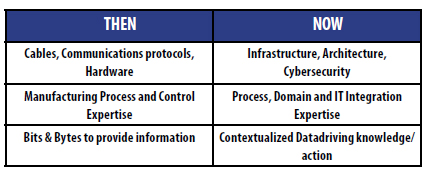
Today, infrastructure, architecture and cybersecurity are non-negotiable foundations. Without them, the house will crumble; however, there also must be a balance of affordability and value-driven priorities while maintaining a secure environment. For instance, if user solutions which require wi-fi are being implemented, then infrastructure expansion must be part of the investment journey. However, be wary of falling into the trap of analysis paralysis, designing architecture on paper, and trying to get it perfect, while no real benefit is realized. The architecture must be flexible and scalable.
A collaborative mindset, in conjunction with modern technology advancements, will be key for continual growth and strengthened collaboration. The creative and technically sophisticated minds of manufacturing and operations trailblazers all those years ago remain at the core of any successful transformation.
Far too often, I’ve observed departments functioning in silos. For example, a software solution is selected and even purchased, but there has been no vetting of the solution from an vendor support, architectural or cybersecurity perspective, no discussion of how it will be accessed, how data will traverse domains, or how it will be maintained.
Not only should we aspire to have technical convergence and integration, the organizations, the people and talent, must converge as well. There must be a mix of process, domain, and integration expertise. Organizational lines must blur and we must think broader and bigger. The most successful organizational model I’ve have the pleasure of leading was a global team comprised of people with IT backgrounds and people who came from a plant/factory with hands-on experience. The team members were a mix of IT and manufacturing/ engineering experts and developed cross-functional skills by collaborating with each other. This resulted in a very strong team. At times, I would partner with HR and a plant manager to develop objectives of a temporary immersion assignment for my employees who would go to a plant for a short-term assignment.
The responsibility and obligation to build relationships begin with the leader and must be top-down. Digital Transformation requires leaders in IT and the Business to have a close relationship and be aligned as partners and to communicate this bond to their organizations. The respective organizations can sense just how effective this collaboration is. Remove the organizational boundaries and focus on relationships.
A collaborative mindset, in conjunction with modern technology advancements, will be key for continual growth and strengthened collaboration. The creative and technically sophisticated minds of manufacturing and operations trailblazers all those years ago remain at the core of any successful transformation. This is exactly how we need to continue. And fast.

