
A featured contribution from Leadership Perspectives, a curated forum for enterprise technology leaders, nominated by our subscribers and vetted by the CIOApplications Editorial Board.

Irby Construction Company
From Neural Networks to Job Sites: How AI Is Transforming Construction Management
From there, I moved into robotics. We used early neural network systems - like the Hecht-Nielsen neural computer - to merge computer-generated imagery with live video feeds for a tele-robotic system for the Space Shuttle / Space Station and even Mars. It was cutting-edge work for its time. Our goal was to model an “earthworm brain.” That neural science architecture, rudimentary by today’s standards, laid the groundwork for the explosion of artificial intelligence we now see in everyday tools like ChatGPT, Copilot, and more.
My industry now? Construction! It is slow to embrace innovation, but it’s amid a technological renaissance. The tools being developed today—powered by AI—are reshaping how buildings, cars, and powerlines are designed, managed, and built. This isn’t hyperbole. It’s a tangible shift driven by a combination of craft labor shortages, safety requirements, rising costs, tighter schedules, and digitized data begging to be put to work.
The Construction Data Problem - Now an AI Opportunity
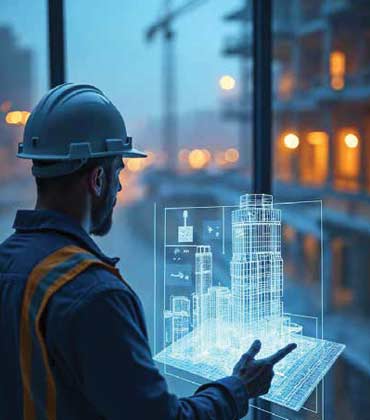
At its core, construction management is a coordination problem: safety, budgets, timelines, craft labor, materials, machinery, regulations, weather, and client demands all intersect in a constantly changing environment. For decades, project managers relied on spreadsheets, whiteboards, and mainly instinct. But today, construction sites can generate massive amounts of data - from robots, drones, 3D scans, sensors, wearables, and daily reports.
This is where AI shines: digesting complex, high-volume data, recognizing patterns, and producing actionable insights. What once took days to assess, AI systems can now summarize and flag in minutes.
AI on the Job Site: Real-World Impact
Here’s what the AI boom looks like on the ground:
Augmenting Craft Labor: The most valuable resource on a job site is skilled craft labor.
Project Planning and Progress Tracking: AI improves construction analytics by turning complex, dynamic data into clear, actionable insights.
Predictive Analytics: By analyzing historical project data, weather trends, labor logs, and equipment usage, AI models predict potential delays, budget overruns, or safety risks before they happen. Systems can generate actionable data. This turns reactive management into proactive decision-making.
AI transformation in construction isn’t about machines replacing people but augmentation. The future is a hybrid: craft labor and machines working side by side, each doing what they do best
Safety Monitoring: AI-driven image recognition systems can watch for unsafe behaviors – poor driving, workers’ PPE, potential weather events, etc. Then, it can alert site supervisors in real time. It’s like having dozens of virtual safety officers always on watch.
Material and Equipment Management: AI tools help track inventory, forecast material needs, and optimize fleet usage. They improve maintenance, reduce downtime, and prevent cost overruns due to over- or under-usage.
From Research to Reality
I started in the early days of neural networks when their capabilities were measured in “worm brains”, to see that change to now being able to manage the chaos of multimillion-dollar construction projects. The core idea hasn't changed: learn from patterns, generalize across inputs, and produce reliable outputs. However, what’s different today is the current scale and accessibility.
Modern AI platforms don’t require a PhD in Mathematics to use. Construction managers, site engineers, and foremen interact with AI through intuitive dashboards, natural language interfaces, and automated reporting systems. This democratization of advanced technology accelerates adoption in an industry where margins are thin, schedules are tight, and errors are costly.
Challenges Remain
Integration isn’t perfect yet. AI needs clean, consistent data to function best - something construction jobs don’t always provide. Interoperability between tools remains a challenge.
This industry still experiences cultural resistance, where intuition and experience are prized over algorithms, and there is a disdain for technology.
There are also concerns around job displacement. While AI isn’t replacing skilled labor yet, it is changing job roles. Today's construction industry professionals need to understand data flows and digital systems in addition to concrete and steel.
The Future Is Hybrid
Ultimately, the AI transformation in construction isn’t about machines replacing people but augmentation. The future is a hybrid: craft labor and machines working side by side, each doing what they do best.
I’ve seen the evolution from the early days of robotic perception using rudimentary neural networks to today’s AI on million-dollar construction projects.
AI technology didn’t just grow up . . . It showed up with work boots on!

