
A featured contribution from Leadership Perspectives, a curated forum for enterprise technology leaders, nominated by our subscribers and vetted by the CIOApplications Editorial Board.

ALDO Group
From Reactive To Agentic: Why The Next Competitive Edge Belongs To Autonomous AI

Through this article, Nayebi highlights that CIOs need to use AI that can act independently to help businesses move faster, make quicker decisions, and stay ahead of the competition.
The CIO’s New Mandate
“Move faster—without breaking anything.” Whether you run turbines, trucks, trading desks or telemedicine, the operational tempo is rising and the tolerance for delay is falling. Descriptive analytics can tell you what happened; generative AI can write about it. Agentic AI goes one step further: it acts—continuously, autonomously, and at digital speed—so the enterprise keeps pace with the market instead of chasing it.
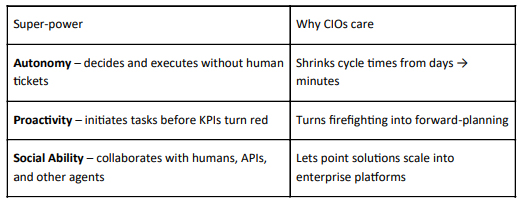 What Makes AI “Agentic”?
Think of an agent as software with three super-powers:
A simple mental model is the Perceive → Reason → Act → Learn loop. Sensors, logs and APIs feed live signals; large language models (LLMs) and optimisation engines plan; micro-services or robots execute; results flow back as training data. The loop never sleeps.
Inside the Box: A Pragmatic Architecture
1. Foundation Models – LLMs, vision and audio models provide raw intelligence.
2. Data Ops – real-time pipelines that keep the models fed and honest.
3. Agent Frameworks – BDI, OODA, ReAct or LangGraph orchestrate goals, tools and memory.
4. DevTooling – sandboxes, simulators and guardrails for safe iteration.
5. Deployment Fabric – cloud, edge, serverless—whatever meets latency and cost.
6. Ecosystem Layer – the agent must influence business apps, devices and workflows. Observability (“Why did the agent reschedule the plant?”) and Governance & Security (“Can it ever trigger a payment without multi-factor authentication?”) cross-cut every layer.
Identify one workflow where hours matter, wire up a closed-loop agent, and let the results speak. If it feels uncomfortable, you’re probably on the right track, because yesterday’s comfort zone is exactly what tomorrow’s autonomous competitor plans to exploit
Where It Pays Off First Getting There Without a Rewrite
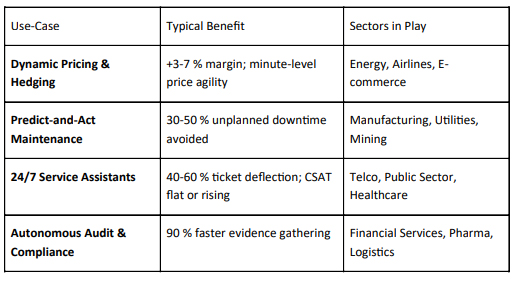 1. Pick a pain point, not a moon-shot. Pilot where latency already hurts—e.g., rerouting freight when a bridge closes.
2. Instrument first, automate second. You can’t fix what you can’t measure; wire up real-time data feeds and observability dashboards before giving agents the keys.
3. Start with a “90-10 guardrail.” Let the agent autoapprove changes within a ±10 % envelope; escalate the rest. Envelope widens as trust grows.
4. Blend frameworks; don’t worship them. BDI is great for long-horizon planning, OODA shines in sub-second trading, and ReAct handles multi-tool workflows.
5. Treat prompts as code. Version them, unit-test them, and security-review them. A rogue temperature setting can leak PII as surely as a SQL injection.
What Changes for IT & Data Leaders
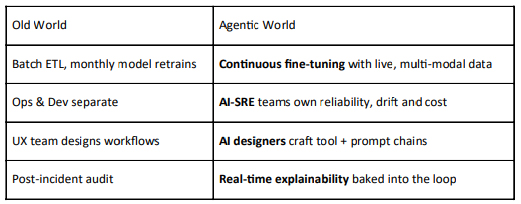 Skill needs to shift accordingly: prompt engineers, causal-inference analysts and AI-SREs join the roster beside cloud architects.
Risks Worth Managing Up-Front
• Over-automation. Keep a human override for brand, legal and ethics.
• Hallucination & Drift. Ground LLM calls with retrievalaugmented generation and short-context memory.
• Shadow Cost. Token bills and GPU hours can spike— monitor ROI like any other cloud metric.
• Vendor Creep. Design for model portability; today’s darling may be tomorrow’s also-ran.
A Three-Quarter Roadmap for the Enterprise
CIO
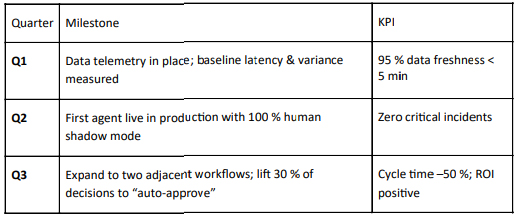 By the end of year one, leadership should expect at least one P&L-visible win—lower outage minutes, faster quote turnaround, or double-digit NPS gains.
The Bottom Line
Generative AI got boardrooms talking. Agentic AI will force them to move. For CIOs, the playbook shifts from building dashboards that describe the business to deploying agents that run parts of the business responsibly, transparently, and at a cadence humans simply can’t match. The enterprises that master that shift will turn volatility into competitive advantage; the rest will keep writing post-mortems on decisions made too late.
Your next action? Identify one workflow where hours matter, wire up a closed-loop agent, and let the results speak. If it feels uncomfortable, you’re probably on the right track, because yesterday’s comfort zone is exactly what tomorrow’s autonomous competitor plans to exploit.

