
Thank you for Subscribing to CIO Applications Weekly Brief


Enterprises are moving quickly from AI experimentation to AI deployment, but many are discovering that model performance is only part of the challenge. The harder problem is data. AI needs access to the full enterprise context, yet that context is scattered across clouds, data lakes, warehouses, operational systems, streaming platforms, and on-premises environments. Centralizing all of it is slow, expensive, and often unrealistic. As AI moves closer to operational decision-making, incomplete or poorly governed data access can limit accuracy, increase risk, and slow adoption. Starburst’s answer is to create an enterprise intelligence layer that brings governed access, metadata, business meaning, and agentic execution across distributed data environments.
For AI, broader governed access is especially important. Models and agents are only as useful as the data available to them. When relevant data is missing, incomplete or inaccessible, outputs become less accurate, less reliable, and more likely to reflect an incomplete view of the business. Federation gives teams a way to bring more of the right data into AI workflows without creating new copies or waiting for multi-year consolidation projects.
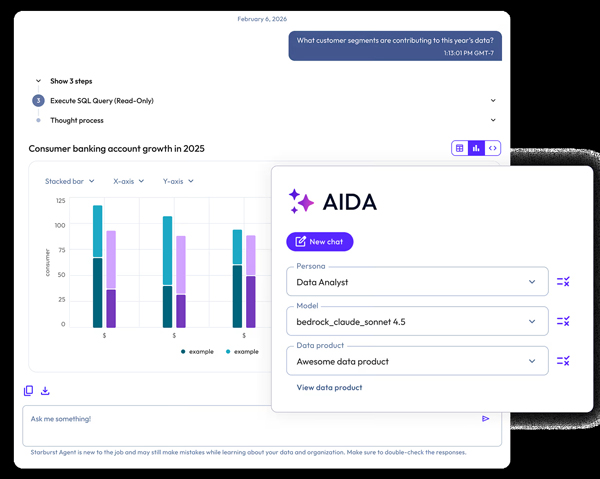 The Starburst Enterprise Intelligence Platform enables organizations to query, govern, and analyze data across systems, helping teams create value without waiting through multi-year migration efforts.
“The goal is to help customers deliver on their AI ambitions and solutions by working with data where it already lives, rather than forcing it into a new system,” says Matt Fuller, VP of AI/ML Products.
Fuller emphasizes that distributed data is not a temporary phase for most enterprises. It is the operating reality. This shifts the focus from moving data into one location to making it usable, governed, and actionable across environments.
A Four-Layer Approach to Enterprise AI
The Starburst Enterprise Intelligence Platform is designed to operate across distributed data environments. The platform allows teams to work across data lakes, warehouses, operational systems, cloud platforms, and on-premises environments without requiring large-scale relocation. This helps teams generate insights faster while avoiding the cost, complexity, and delay of large migration programs. Underpinning this approach is a four-layer architecture, with each layer addressing a specific challenge that organizations face as they scale AI initiatives.
The foundation is the analytics engine, which addresses the problem of fragmented data. Enterprises often store information across data lakes, warehouses, operational systems, cloud platforms, multiple clouds, and on-premises environments. The analytics engine provides access across these environments, allowing organizations to begin extracting value without forced migration. Above it sits the context layer, which addresses another critical challenge: AI systems need more than data access to produce accurate, trusted results. The context layer enriches data with business meaning, metadata, governance, lineage, access controls, and definitions so AI systems can better understand what the data represents and how it should be used.
The agentic control plane builds on this foundation by coordinating models, tools, agents, and workflows across the platform. This gives the enterprise a way to move from isolated AI interactions to governed AI-driven processes. It allows organizations to move beyond simple question-and-answer interactions toward AI-driven processes that support decisions, coordinate tasks, and initiate action.
At the top of the stack is AIDA, which provides a natural-language interface for business users. Teams can ask questions using everyday business language, interact directly with governed data, and trigger actions through conversational requests, expanding access to insights beyond technical users.
Together, these four layers enable organizations to operate across hybrid environments while supporting the accuracy, scalability, governance, and flexibility required for enterprise AI.
The Rise of the Context Layer
Making data available is only part of the challenge. For AI systems to generate reliable insights, they must also understand what the data represents, where it came from, who can use it, and how it maps to business meaning. Starburst addresses this through a ‘context layer’ that enriches federated data with metadata, governance, and business meaning. Instead of leaving interpretation to guesswork, data is organized into governed data products that carry lineage, access rules, and business definitions.
As Fuller explains, “The combination of providing the business meaning and the data itself gives the proper context to AI.”
This becomes critical when AI systems are used by business users. People do not ask questions in schemas or column names. They use business language. Without a bridge between technical data and business meaning, even the most advanced models can misinterpret results.
By combining broad data access with consistent metadata and business context, Starburst helps reduce hallucinations, improve accuracy, and gives organizations greater confidence and trust as they move AI applications into production.
Federation as the Foundation for Data Access
With meaning and governance in place, how queries are executed across systems becomes just as important. Starburst addresses this through federated data access. The platform allows users to query data across multiple systems through a unified access layer. Query processing can be pushed closer to the data, reducing unnecessary movement. Because data will continue to exist across multiple systems, organizations need a way to operate across that structure while preserving governance and control.
-
The goal is to help customers deliver on their AI ambitions and solutions by working with data where it already lives, rather than forcing it into a new system.
For AI, broader governed access is especially important. Models and agents are only as useful as the data available to them. When relevant data is missing, incomplete or inaccessible, outputs become less accurate, less reliable, and more likely to reflect an incomplete view of the business. Federation gives teams a way to bring more of the right data into AI workflows without creating new copies or waiting for multi-year consolidation projects.
Organizations can derive value from existing data environment while still maintaining compliance with data residency and governance requirements.
A financial services use case shows why this matters. In an anti-money laundering scenario, data was distributed across regions with strict regulatory boundaries. Rather than moving sensitive data across borders, Starburst enabled compute to run close to where the data resided, allowing AI models to analyze it collectively while maintaining compliance controls. The result was faster detection of suspicious activity and a measurable reduction in regulatory risk.
From Insight to Action: Agentic AI
Starburst’s agentic capabilities are designed to help organizations move beyond static dashboards, manual handoffs, and traditional business intelligence workflows. Through AIDA, users can access governed enterprise intelligence through a conversational interface that brings together data access, business context, analysis, and action.
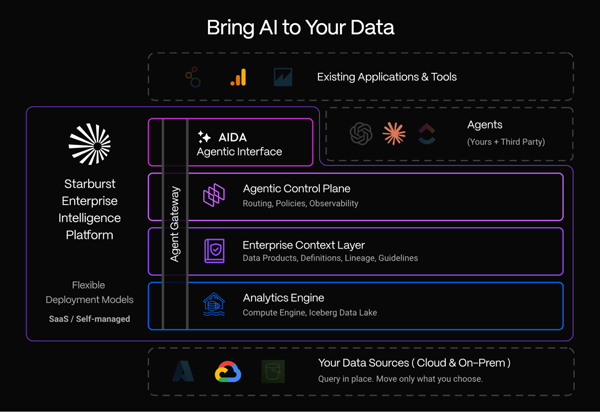 For example, a user could ask the system to identify potential security threats, locate and analyze relevant datasets, assess potential risks, and notify the appropriate team through tools such as Slack. AIDA can also connect to external MCP servers, allowing agents to use approved tools to perform actions in the systems where teams already work.
As Fuller notes, “This is not simply about generating answers, but enabling systems to take action.”
This foundation enables organizations to work with governed information while reducing reliance on static dashboards and manual reporting processes. Teams can interact with data through natural language, uncover relevant insights, and initiate workflows from the same environment, shortening the time between identifying an issue and responding to it.
Built for Openness, Not Lock-In
Starburst is designed to connect the systems enterprises already use. Built on open technologies such as Trino, Apache Iceberg, and aligned with emerging standards such as the Open Semantic Interchange (OSI), the platform integrates across systems without requiring organizations to rebuild their architecture. Its Model Context Protocol (MCP) server enables seamless interaction between agents, tools, and data systems, allowing organizations to extend their existing ecosystems.
This openness extends to how Starburst fits into existing data stacks. For example, organizations using AWS Glue as their data catalog can query and work with their data without first migrating metadata into a new system. This lowers the barrier to adoption and supports a key priority: immediately delivering more value from existing technology investments.
The Future of Enterprise AI Architecture
As enterprises move AI into production, two requirements are becoming unavoidable: access to all relevant data and the context needed to interpret it correctly.
For Starburst, that future focuses on enabling systems to work together across clouds, on-premises environments, and an increasingly complex ecosystem of tools and agents. This approach has contributed to Starburst’s recognition as AI Data Lakehouse Platform of the Year, reflecting its ability to unify distributed data, context, and AI-driven execution in real-world enterprise environments.
Enterprise AI will succeed when the systems behind the models can deliver trusted context at the speed of business. By enabling organizations to work with data across distributed environments, Starburst helps shift the focus from infrastructure complexity to decision execution. In doing so, it moves AI closer to reliable, everyday enterprise use.
Deep Dive
Context before Consolidation: Rethinking the AI Data Lakehouse
Enterprise AI initiatives rarely fail because of model limitations; they stall when data remains fragmented across systems that were never designed to work together. Organizations attempting to centralize everything into a single repository encounter a structural constraint: data does not stay still. It spans on-prem systems, multiple clouds and specialized platforms, often governed by regional, regulatory or architectural boundaries that resist consolidation. The result is not just technical complexity but delayed value, where insight delivery is gated by multi-year migration programs that never fully conclude.
This persistent dispersion forces a different question. Instead of asking how to move data into one place, executives now evaluate how effectively a platform can work across where data already exists. The ability to query and analyze without relocation changes both time-to-value and architectural risk. Enterprises no longer need to pause innovation while infrastructure catches up; they can act on existing data landscapes immediately, reducing dependency on large-scale transformation efforts that often outlive their original assumptions.
That shift introduces a second, less visible constraint: context. Access alone does not make data usable in an AI-driven environment. Business users interact through domain language, while underlying systems encode data in technical structures that rarely align. When AI operates without this translation layer, accuracy deteriorates and trust erodes quickly. Organizations experimenting with generative or analytical AI frequently encounter this gap, where outputs appear plausible but lack grounding in business meaning, limiting production adoption.
Addressing this disconnect requires platforms that can bind technical metadata with business interpretation at scale. Governance, lineage and semantic clarity must travel with the data, not remain confined to isolated systems or documentation layers. Enterprises evaluating solutions increasingly look for the ability to create governed, curated data constructs that preserve meaning across environments, ensuring that AI systems operate on context rather than raw inputs.
A third pressure point emerges from the growing expectation of immediacy. Decision cycles are compressing, and reliance on pre-built dashboards introduces latency that modern operations cannot afford. Business users expect direct interaction with data, often through natural language, without waiting for engineering or analytics teams to intermediate. Platforms that expand access while maintaining control over accuracy and governance are reshaping how organizations think about analytics delivery.
Openness further complicates the decision landscape. Enterprises rarely operate within a single vendor ecosystem, and prior investments in catalogs, storage formats or processing engines remain relevant. Lock-in is not just a cost concern; it limits adaptability in an environment where data architectures evolve continuously. Buyers increasingly prioritize platforms that integrate with existing systems, support hybrid and multi-cloud environments and allow incremental adoption rather than enforced migration.
Starburst aligns closely with this direction through its Enterprise Intelligence Platform, which enables organizations to query and analyze data across distributed systems without requiring movement into a centralized repository. Its architecture integrates an analytics engine capable of high-scale processing with a context layer that binds business meaning to technical data, helping reduce inaccuracies in AI-driven outputs. By supporting hybrid and multi-cloud environments and integrating with existing catalogs and formats, the platform allows enterprises to derive immediate value while preserving prior investments. Starburst’s AI data assistant and agent-based capabilities extend interaction beyond traditional query models, enabling natural language access and task-oriented workflows that accelerate decision cycles. Together, these capabilities position it as a strong choice for organizations aiming to operationalize AI on top of complex, distributed data environments.
...Read more
AI Data Lakehouse Platforms Info
Q1
What Are AI Data Lakehouse Platforms And How Do They Support Modern Data Strategies?
AI Data Lakehouse Platforms combine the flexibility of data lakes with the performance, governance, and analytical capabilities traditionally associated with data warehouses. These platforms help organizations manage large-scale data environments while supporting artificial intelligence, analytics, and machine learning workloads. By enabling access to governed data across different sources, AI Data Lakehouse Platforms help organizations create a stronger foundation for trusted insights and AI-driven applications.
Q2
How Does Starburst Deliver AI Data Lakehouse Platforms For Enterprise Data Needs?
Starburst delivers AI Data Lakehouse Platforms through an open data platform designed to connect distributed data sources without requiring extensive data movement. Its platform supports governed access across cloud, lake, warehouse, streaming, and SaaS environments. Starburst uses technologies such as Trino and Apache Iceberg support to help organizations query, manage, and analyze data across complex environments while maintaining flexibility and control.
Q3
What Capabilities Should Organizations Expect From AI Data Lakehouse Platforms?
AI Data Lakehouse Platforms typically include data federation, governance, analytics support, metadata management, and capabilities for AI and machine learning workloads. These platforms help teams acquire data from multiple locations, establish consistent controls, and prepare information for advanced applications. Important parameters to consider include scalability, interoperability, security, and the ability to support changing data requirements without creating unnecessary complexity.
Q4
How Do AI Data Lakehouse Platforms Improve Data Access And AI Readiness?
AI Data Lakehouse Platforms typically include data federation, governance, analytics support, metadata management, and capabilities for AI and machine learning workloads. These platforms help teams acquire data from multiple locations, establish consistent controls, and prepare information for advanced applications. Important parameters to consider include scalability, interoperability, security, and the ability to support changing data requirements without creating unnecessary complexity.
Q5
What Makes Starburst A Notable Provider Of AI Data Lakehouse Platforms?
Starburst is recognized for developing an open data lakehouse approach focused on enterprise analytics and AI workloads. Its platform provides federated data access, governance capabilities, and support for distributed environments. The company has expanded its capabilities with AI-focused features, including support for AI-ready data products and tools designed to help organizations run AI applications using governed enterprise data.
Q6
How Are AI Data Lakehouse Platforms Shaping The Future Of Enterprise AI?
AI Data Lakehouse Platforms are becoming an important part of enterprise AI strategies by helping organizations combine data accessibility with governance and operational control. As businesses adopt AI applications, they need platforms that can provide reliable context, secure access, and scalable data management. Starburst demonstrates this direction through its focus on connecting distributed data environments, supporting AI workflows, and enabling organizations to use governed information for advanced analytics and AI-driven decision-making.
× 
CIO Applications Weekly Brief
Be first to read the latest tech news, Industry Leader's Insights, and CIO interviews of medium and large enterprises exclusively from CIO Applications
