
Thank you for Subscribing to CIO Applications Weekly Brief


 Dr. Jack Peck, President and Dr. Ed Page, Chairman
With a mission to enhance the speed and accuracy of piece picking for e-commerce, FastFetch patented and developed software to combine voice, light-directed, and wireless barcode scanning technologies into one system to enable a human operator to fill batches of orders in a single trip through the warehouse picking area. Along with its flagship cart-based picking technology, the company also developed several other types of order fulfillment systems. FastFetch is a pioneer in delivering mobile cart solutions for batch picking customer orders using tablet computers with lighted numeric displays on both carts and product bays. Using voice output and on-screen commands, a picker is directed to travel to a product bay and uses light modules (small electronic devices with a numeric display, an LED that flashes and a light sensitive proximity switch) on product bay locations and light modules on order cart locations to quickly find and retrieve products on bays and place them into containers on carts.
Today, the company is a recognized innovation leader in the distribution and logistics industries owning two U.S. patents, nine international patents and two pending patents. “Our picking solutions have proven their value in diverse distribution environments. These solutions include batch carts, put walls, reverse logistics, pack walls and kitting–and-sequencing for manufacturing with some customers reporting picking rates in excess of 1,100 lines per hour and some reporting filling more than 80,000 orders per shift,” explains Peck, president of FastFetch. FastFetch has been recognized multiple times by professional organizations such as MHI and CSCMP as an innovation leader in logistics technologies.
An Array of Order Management Solutions for Filling Orders
Many clients achieve high productivity by picking multiple orders using the FastFetch Batch Picking Cart process that makes a single pass through the distribution center. The number of orders on a cart for some of these customers is as high as 175.
Before picking begins, the FastFetch system examines all the orders available for fulfillment and batches them into sets to be assigned to order carts. “The batching process uses biologically inspired, Artificial Intelligence (AI) algorithms to optimize the batches of orders to be picked together on order carts in a way that minimizes travel through the DC, maximizes commonality of order items and minimizes wasted shelf space - all while respecting ergonomic constraints such as total order cart weight and weight of single cartons on high or low shelves” says Peck.
The order cartons assigned to an order cart can be of varying sizes, as determined by the FastFetch AI based cartonization algorithm that uses 3-D placement to computationally rotate items in available cartons to guarantee the selected carton can pack the order items with minimal wasted space (air).In selecting the right sized carton, this algorithm also considers item properties such as nesting, hollow fill, “this side up”, layering (items can have nothing packed on top of them) and exclusion/inclusion pairing of carton types and item types. If no carton is large enough to contain all the order items, the algorithm breaks down the order into multiple cartons, each with minimal air. Finally, the AI-base algorithm was tuned to execute in less than a second for item counts less than 50 and carton counts less than 100.
The cart-based solution uses a tablet to guide a human picker using voice commands to reach the target location for picking products for one or more customer orders. Using infrared technology (the same technology used in remote controls for home electronics) on the order cart and product bays, the order tablet computer polls for a target product bay, and when the bay is reached the bay responds with an infrared message and the cart says, STOP! The cart then sends an infrared message to the bay to illuminate quantities in one or more light modules adjacent to picking locations where product should be retrieved. After products are retrieved, a light sensitive proximity switch is triggered by waving a hand or product within 1 inch of a flashing LED to confirm correct picking. In a similar manner, light modules on carts are illuminated, showing where and how many of the picked products should be placed into order cartons on the cart, and light sensitive proximity switches on cart light modules are triggered to confirmed correct placement. Optionally, bay locations with slow-moving products need not contain light modules. In these cases, bar code scanning of either the product or bay location barcodes can be used to confirm correct retrieval of products.
Our objective is to be the best solution available for the widest variety of picking applications, all utilizing the same software and all interfacing with warehouse management systems, enterprise resource planning systems, and homegrown warehouse systems
Light modules on carts can still be used to indicate where and how many retrieved products should be placed in order cartons. FastFetch also offers LED strips as an alternative to light modules on picking bays. These LED strips typically reduce the costs of bay lights by more than 80 percent.
In one engagement, a Wisconsin-based client, with costumes and party supplies as their prime products, was faced with filling 55,000+ orders per day in the two months preceding Halloween. In order to handle this volume, they previously needed to hire about 325 workers on a temporary basis and lay them off after the busy season. With shrinking available labor markets, this became virtually impossible. Furthermore, filling this volume of orders using the voice technology solution they purchased two years before was impossible since training time was long and resulting quality was unacceptable. After deploying 60 FastFetch AI-based, batch-picking carts (with 30 orders/ cart) to replace 100 voice units, the client increased its daily ordervolume from 25,000 orders/day to 55,000+orders/ day. They went from 3 shifts/day working 6 days/week to one 14- hour shift working 5 days/week while reducing their workforce from 325 temporary workers to about 130 workers, most of whom were employed full-time. This resulted in huge savings with greatly increased efficiency and accuracy. Using the FastFetch solution, the temporary worker and order volume problems were solved.
If the picking area is extremely large, batch cart picking, even with 50 orders per cart, may not be fast enough. FastFetch also offers a put wall solution to reduce the walking time to fill large numbers of orders (e.g. 500 orders). A FastFetch put wall consists of a two-sided frame of compartments (“cubby holes”) where one side is used for building customer orders in the compartments and the other side is used for packing completed orders.
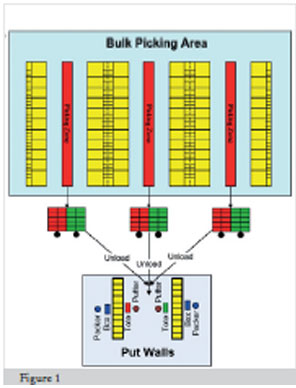
Using the FastFetch batch cart picking system, pickers use bulk carts to retrieve products in aggregate for large numbers of orders and place the products into mixed product totes, each of which is assigned to a specific put wall. The totes are then taken to their assigned put walls where one or more putters scan products from the totes and place them into compartments as directed by quantities displayed in light modules adjacent to the compartments. When a picker scans a product, one or more light modules adjacent to compartments illuminates to display the quantity of the product needed for the orders assigned to those compartments. When all products of an order are placed in a compartment, the FastFetch system illuminates a light module on the pack side of the put wall with a carton ID that is best suited for packing the order with minimal wasted space. Multiple packers can work simultaneously to remove products from completed compartments and pack them into cartons indicated by light modules. When a compartment has been emptied, the flashing LED in the associated light module on the rear of the compartment is triggered so the compartment can be reused for another order. By this means, the put wall can be “over committed” to process more orders than its capacity. See Figure 1.
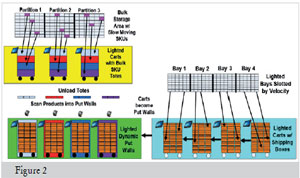
A problem with put walls is that each item must be handled (touched) 3 times–once when it is picked in bulk, once when it is scanned and placed in a put wall compartment and once when it is removed from the put wall compartment and packed. Because FastFetch designs its own hardware and writes its firmware and application software, own before the word firmware it can dynamically change the way the hardware functions to create variations of the basic put wall picking method to retain the reduction the walking distance but also avoid most of the touches. Peck calls the new method, Dynamic Put Walls. See Figure 2
The Dynamic Put Wall solution uses light-directed order carts loaded with shipping cartons to batch pick products from “slotted” picking areas (areas that store high-velocity, popular products that are picked often). Based on the 80-20 rule (80 percent of the items ordered come from 20 percent of the products), at the conclusion of batch picking from the slotted area 80 percent of the required products are in the order carts shipping cartons. Concurrent with this batch picking process, the remaining 20 percent of required items are batch picked in aggregate from a larger area of low-velocity, less popular products and placed in mixed product totes on bulk carts, one tote for each order cart of shipping containers. The FastFetch tablet software on each order cart then sends a command to the order cart FastFetch firmware to digitally transform the cart hardware to function as a put wall. The items in totes are then scanned and light modules on the put walls (formerly order carts) are illuminated with quantities identifying the cartons where the quantity of the items must be put. Consequently, 80 percent of the items require only 1 touch (due to picking popular items into shipping cartons) and the remaining 20 percent of the items are touched 2 times rather than 3 times since items are placed directly into the shipping cartons, thus eliminating the packing touch.
Many companies find slotting products (i.e. moving products to DC locations to group popular items close to one another and reduce walking time) too time consuming and too disruptive to picking and replenishment operations to perform often. Consequently, many companies never slot their products or only slot them a few times per year.
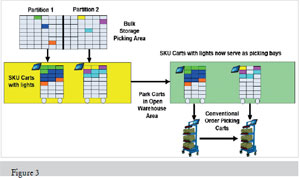
Another picking method made possible by FastFetch’s unique hardware enables a company to slot their products on each wave (a wave is a subset of all available orders that is scheduled to be picked in a defined time period, for example this morning) without moving the product or disrupting DC operations. Peck calls this new picking method, Dynamic Slotting. See Figure 3.
With this method, orders are picked in aggregate by product type onto multiple bulk carts with light modules, where each product type is placed in a separate cart location. These bulk carts are then parked in an empty area in the DC and the bulk cart FastFetch firmware in each cart is digitally transformed by commands from the FastFetch tablet software to make the bulk cart operate as a picking bay with light modules. Batch order carts loaded with totes or shipping cartons are then moved to this smaller, slotted picking area containing the product bays (formerly bulk carts) and the FastFetch Batch Picking Cart process described earlier is performed.
The company’s most recent innovative solution, with a U.S. patent pending, is the FastFetch Shipping Cost Optimization System that Peck calls, “IntelliPack.” Using AI, this solution reduces shipping costs, corrugated material costs, dunnage costs and labor costs by enabling carton selection from a large number of carton sizes (e.g. 40 or more carton sizes) readily available to packers near loading or packing stations. Using the dimensions of picked items, the solution quickly determines the optimally sized shipping carton to select (or to make if a carton making machine is used). A carton rack holding a small cache of flat, unerected cartons of each size, has LED strips mounted beneath shelves. Once an order bar code is scanned, IntelliPack retrieves the order items dimensions and weight and quickly determines (in less than 1 second) the optimal carton size for an order. IntelliPack then illuminates a segment of LEDs on the carton rack to quickly bring the location of the optimal carton to the attention of a packer (or cart setup worker if the carton rack is used before picking). The FastFetch Batch-Picking Cart solution is subsequently used to pick flat cartons from a carton storage area to replenish consumed cartons on carton racks. Finally, the carton manufacturer is sent consumed carton size totals so vendor managed inventory can be used to deliver cartons periodically to restock the carton supply area. With frequent restocking from the carton manufacturer, the total carton inventory of a larger number of carton sizes is often less than the larger inventory of a smaller number of carton sizes.
Easy Installation, Maintenance, and Fault Tolerance
Design features that distinguish FastFetch’s solution from its competitors are its ease of installation, ease of maintenance, and fault tolerance. Installation requires only a drill and screwdriver. Wiring is also simple since CAT5 cables are used to connect controllers (small devices that receive commands from a tablet and communicate these commands to light modules) and light modules in both picking bays and carts in a daisy chained, shelf to shelf, serpentine pattern.
Fault tolerance is provided in multiple ways. If a light module fails, the failure is detected by the controller and communicated to the tablet that in turn instructs a picker to use a scanner to confirm picking rather than attempting to use the failed light module. The failure is then reported to maintenance personnel who replace the defective light module. The cart tablet contains a database of all orders on the cart so if the Wi-Fi connection fails or the cart travels to a dead spot in the DC, the cart continues to direct picking and updates the local tablet database. When the cart reestablishes Wi-Fi communication, the tablet local database is automatically synchronized with the host database to enable real-time reporting. If the cart tablet fails then a spare tablet can be attached to the cart and a batch barcode scanned to request a download of the current state of the picking process so the replacement tablet can resume at the point of failure.
Maintenance of the system is simplified by FastFetch software that diagnoses problems and identifies failed components. Replacement of a failed light module only required unclipping the RJ45 modular clips on each side of the daisy chained light module, clipping a replacement light module in place of the failed unit and activating a switch on the new module. The controller will automatically detect the newly attached light module and assign it the same address of the failed module.
Finally, the system is 100 percent scalable since each product bay is only connected to a 24-volt power supply and is not connected to a central control computer. Commands are sent from a cart tablet to a product bay via infrared communication. Because of this distributed architecture, additional product bays or additional carts can be placed in production without affecting the performance of existing bays or carts. Each cart only communicates with the product bay with which it is in session.
Support is provided via remote connection from the FastFetch office. When a client calls in, FastFetch support personnel can connect with the production system, look at the production database, and even reach out to a cart tablet to diagnose the problem. “We assign a project manager early on and create a written, functional design document to which both the client and FastFetch agree. Then we create a technical design document that programmers use to implement any enhancements that may be required,” says Peck. The personnel who prepared the functional and technical design continue as part of the implementation team. After the project goes into production operation, the project trainer provides 1st level support and the project software engineer provides 2nd level technical customer support. Fortunately, support calls are infrequent and are usually solved at the 1st level.
Following the path of innovation, FastFetch is continually looking at new growth opportunities through innovation. “We learn a lot from our clients. When we look at new problems they bring to us, we develop innovative solutions to those problems. Sometimes these innovative solutions are the basis for new products,” states Peck. By developing innovative solutions, FastFetch continually works to meet new client requirements that simplify their order fulfillment processes. “Our objective is to be the best solution available for the widest variety of order fulfillment and packing applications, all utilizing the same software and all interfacing with any warehouse or order management system, enterprise resource planning systems, and homegrown warehouse systems.”
October 25, 2019
× 
CIO Applications Weekly Brief
Be first to read the latest tech news, Industry Leader's Insights, and CIO interviews of medium and large enterprises exclusively from CIO Applications
