
Thank you for Subscribing to CIO Applications Weekly Brief


 John Proctor, SVP of Marketing
Established in 2011, Berkeley Lights is a pioneer and leader in finding the best cells to accelerate the use of cell-based products, delivering novel technology that fundamentally change research using cellular biological processes. Berkeley Lights has introduced a complete solution to find the best cells by functionally screening and recovering individual cells while accelerating the rate at which cell-based products are discovered and developed—a fraction of the time required in conventional, legacy research approaches. The company's innovative, Optofluidics-based technology enables real-time, live, non-destructive, and iterative interrogation of thousands of single cells in integrated, end-to-end workflows, accelerating the use of cell-based products.
In an interview with CIO Applications, John Proctor, Senior Vice President of Marketing at Berkeley Lights, discusses his company’s robust technology and platforms, and how they are delivering cell processing and deep profiling with unprecedented information about cell function.
How does Berkeley Lights accelerate the discovery and development of cell-based products?
Cells are capable of manufacturing cures for diseases, fibers for clothing, energy in the form of biofuels, and proteins for nutrition. However, the challenge lies in finding the right cell for a specific job. That's where we excel: We are capable of finding and delivering the best cells for various cell-based applications. In essence, using customer defined criteria, we look for and identify the cells that are producing the products of their interest and are of high value to them. We believe that to discern the right cell, it is crucial to have the right definition of product characteristics in question. With our technology, we are able to deliver to our clients single cells that are producing the right product with the right profile.
For instance, in the antibody therapeutics market, biologists require live cells for new drug development and manufacturing. However, to find the right live cell or group of cells, they have to screen millions and millions of cells, which is both labor-intensive and time-consuming. We are successfully improving the odds by creating the most advanced environment for the functional testing of single cells and leveraging our complete solution to accelerate drug discovery, development, and scaling of cell-based products.
What are some of the challenges your clients face?
Biotechnology companies are constantly pushing the envelope to find and develop new therapies and drugs.
While doing so, they are actually adding more molecules into their pipeline, which could become the next effective, safe, revenue-producing biologic drug. To meet that demand and increase the probability of finding the right cell, we are persistently improving our products and enhancing the abilities and magnitude by which we can screen different populations of cells.
Oftentimes, it is necessary for biologists to understand the genotype of the cells while developing the products. However, today, it's exceedingly difficult to link the phenotype, or the characteristics defined by the customer, to the underlying genotype of the exact cells producing the product. This has emerged as a major bottleneck in the drug development process, and we are on our way to developing effective means to solve it.
With our technology, we are able to help our customers find the best cells to accelerate the use of cell-based products in various fields
Oftentimes, it is necessary for biologists to understand the genotype of the cells while developing the products. However, today, it's exceedingly difficult to link the phenotype, or the characteristics defined by the customer, to the underlying genotype of the exact cells producing the product. This has emerged as a major bottleneck in the drug development process, and we are on our way to developing effective means to solve it.
Could you tell us more about the technology that you use?
At the core of Berkeley Lights' technology is Optofluidics, which uses light and semiconductor technology to move individual cells so that they can be isolated, assayed, and exported. We use specialized microscopes to visualize cells on a consumable—a microchip. On the consumables, we use our technology and light to capture and move individual cells into tiny wells, called NanoPenTM chambers, where they can be assayed.
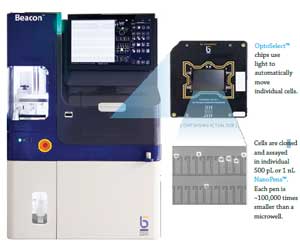
To keep the cells alive, we flow cell media onto the chip, which provides them with nutrients and growth factors. When left on the consumable long enough, the cells divide and grow just like they would in a bio-reactor or an incubator. Once we gather all the data we need from the cells, we use light to move them out of those NanoPens into a well plate where researchers can perform further experiments. For example, they can choose to turn the cells into a big batch to produce the product they need. We can even capture the genomic information of the single cells that were interrogated or assayed on the chip. This combination of light and fluidics, which we call Optofluidics, ensures precise control over every experiment and allows us to perform that experiment on tens of thousands of individual cells simultaneously.
Can you cite a customer success story?
Amgen, who is one of our customers, has published that the Berkeley Lights technology has immediate applications and abundant long-term potential. With the help of our Beacon® Platform, Amgen can now miniaturize and integrate experiments using the microchips, which were previously done on several different devices. They are able to quickly see which cells are making antibodies, if the antibodies bind to their target, and if that binding has the desired impact on the target’s biology. Moreover, the Beacon’s scaled-down NanoPens allow individual antibody-secreting cells to thrive long enough to generate useful data. Using the platform, Amgen is now able to obtain the data they need in hours or days, rather than weeks or months.
Amgen has also shared that the technology is their standard method for cell line development. Traditional cell line development methods are labor intensive—hundreds of plates are needed to increase the odds of finding a good cell line. With Berkeley Lights' technology, biologists are no longer required to observe stacks and stacks of plates in an imager; the platform does it for them. In addition, they can monitor how well the cells are growing and how much antibody they are producing at a very early stage of clone development. More importantly, Amgen demonstrated >99.7 percent monoclonality of cell lines using our platform, which is significantly better than the critical guidance the FDA mandates for new therapeutics.
What does the future hold for your organization?
Witnessing tremendous growth in the APAC region, we opened our regional office in Shanghai, China last year. We will continue to expand our geographic footprint in areas of high growth along with our commercial organizations to not only cater to new customers but also support our current customers. Our platform generates huge volumes of valuable data for researchers, and we are in the process of innovating and improving it to make it more intuitive and help customers develop cell-based products.
× 
CIO Applications Weekly Brief
Be first to read the latest tech news, Industry Leader's Insights, and CIO interviews of medium and large enterprises exclusively from CIO Applications
